
This post may contain affiliate links. Please see our disclosure policy.
Sometimes an ancestor changed his name. Genealogy tips for dealing with name changes in your family tree and finding that ancestor.
When researching your family history, it’s not uncommon to hit a brick wall because an ancestor may have changed their name. Whether the change was for cultural, personal, or legal reasons, this can be a daunting challenge for genealogists.
But don’t worry—there are strategies you can use to overcome this obstacle.
Table of Contents
Why Would an Ancestor Change Their Name?
It happens. Ancestors DID change their names sometimes, and before diving into research, it’s helpful to understand why your ancestor might have changed their name.
Common reasons include:
- Immigration: Many immigrants altered their names to better fit into their new country.
- Avoidance of Debt or Legal Trouble: Some changed names to escape financial or legal issues.
- Personal Choice: A desire for a fresh start or to break away from family could lead to a name change. Another personal choice could be they did not like their name. (That was my ancestor!)
- Cultural Adaptation: Names might be changed to align with local customs or language.
Of course, maybe they wanted to just confuse future researchers! 🤭
Whatever the reason, changing a family surname from the early 1900’s back was really quite simple. One just started using their new name of choice. Researchers are not likely to find a formal record for that name change. It just wasn’t needed.
When this happens, researching ancestry by a last name becomes, well, complicated. What can you as a genealogy researcher do?!
You have some options. Just be prepared this is not a quick process and you will stretch your research muscles. That’s a good thing!
How can I tell if my ancestor changed their name?
Detecting whether your ancestor changed their name can be challenging, but there are several indicators that might suggest a name change has occurred. Here are some clues to watch for:
- Inconsistencies in Census Records: When reviewing census data across different years, pay attention to variations in your ancestor’s name, age, birthplace, or the names of family members. A sudden change in any of these details could indicate a name change.
- Variations in Vital Records: Birth, marriage, and death certificates are crucial documents in genealogy research. If you notice discrepancies in your ancestor’s name across these records, it could be a sign of a name change. For example, a birth certificate might list one name, while a marriage certificate might show a different name.
- Discrepancies in Legal Documents: Legal records, such as wills, land deeds, or court documents, may show different names for the same individual. If your ancestor appears under different names in various legal contexts, it’s worth investigating further.
- Missing Records for Known Events: If you know a particular event occurred, like a marriage or immigration, but cannot find the corresponding record under your ancestor’s known name, it may be due to a name change. Searching for variations or different names might uncover the missing documentation.
- Family Stories or Oral Histories: Sometimes, family lore can hint at a name change. If stories have been passed down about an ancestor changing their name, even if they seem vague or uncertain, it’s worth considering as a potential lead.
- Unusual Gaps in the Timeline: If there’s a gap in your ancestor’s timeline where they seemingly disappear from the records, they may have changed their name around that time. Investigating where they were living or significant events during that period might provide clues.
By carefully analyzing the records you have and looking for these types of inconsistencies, you can begin to piece together whether your ancestor may have changed their name and start exploring alternative names or spellings in your search.
3 Genealogy Research Strategies To Try If You Suspect Your Ancestor Changed His Name
Let’s take a close up look at William Henry Haley of Charlotte County, VA – my ancestor who changed his name.
(This is based on the research report I completed as part of the ProGen Study Group 11.)
Were William Henry Haley and George W. Haley the same man?
William Haley “disappeared” from the records prior to 1883. Despite hours of research, no evidence of William’s existence prior to 1833 could be found. Obviously, he was somewhere! Oral history and William’s earliest known record of existence were the starting point to re-construct William’s early life. [Note: William H Haley was my Great Great Grandfather.]
1.Oral History Can Hold Clues To An Ancestor Name Change
Oral history for William’s life after his 1883 marriage and until his death in the 1940’s is strong and abundant. At the time of this research project, many of William’s grandchildren were still living and passing on their knowledge of his life. Unfortunately, those mentioned in this post have since passed away.
Anita Carr Talbott and Percy Owen (grandchildren of William Haley) provided much of the oral history of William Haley. Both grandchildren knew William Haley personally well into their early adult years. Interestingly, neither knew with certainty the name of his parents. Percy reported that the Tribble family was “somehow related”, but he was unsure of the exact relationship.

Both descendants reported William (known as Will to family and friends) Haley lived all his life in Halifax and Charlotte Counties, VA. As a young man William worked on the Clarkton Plantation as a laborer and even married the overseer’s daughter Clara Holt. William went on to become the overseer of Clarkton Plantation after the death of his father-in-law Branch W. Holt. Both Haley grandchildren also reported that the Haley surname at times was spelled Hailey.
One last clue in the family’s oral history came from Dorothy Adams Haley, wife of William’s son Clyde. Dorothy reported that William Haley’s father was “Cas” (pronounced with a short “a” sound as in “cat”). Beyond that tiny clue, Dorothy did not know if Cas was a nickname or any more about him.
That’s okay. I’d take any clue and all clues!
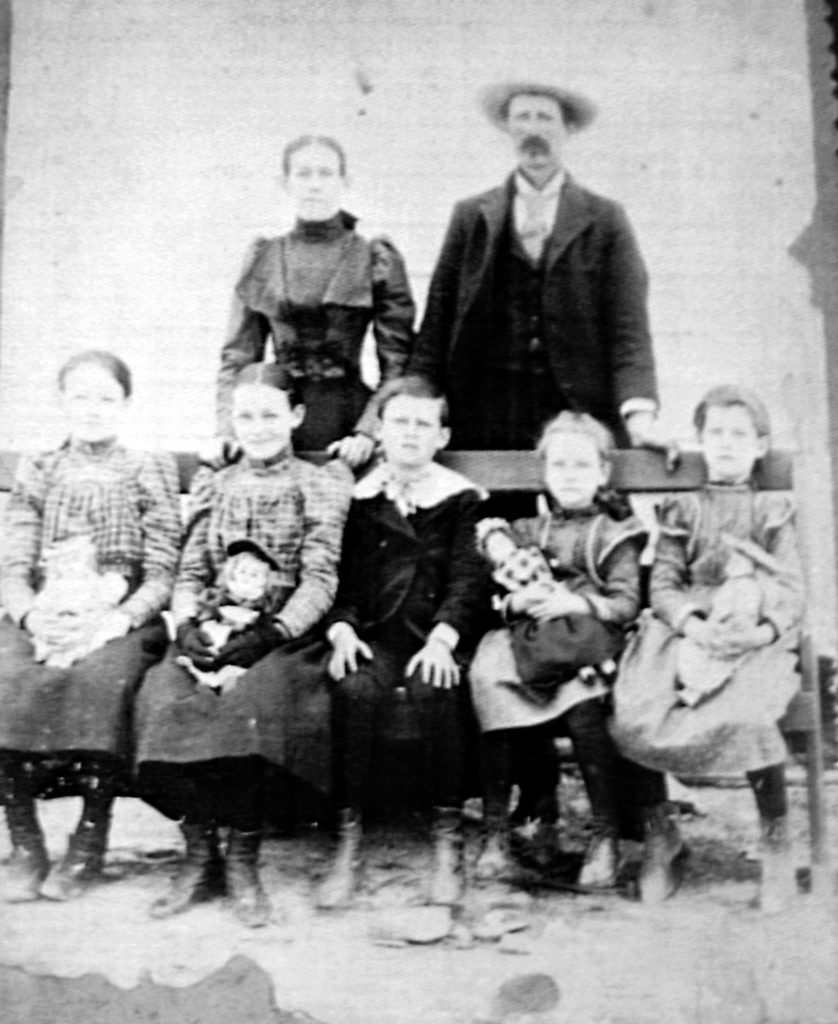
2. Take the Genealogy Research Back to the Traditional Genealogy Records.
Seek out all sources of genealogy information. Do not skip any steps here. Always view the original document when possible. The extra effort is crucial. For example, you may already know your ancestor’s death date and location from another source, but get that death certificate anyway!
DEATH CERTIFICATE
William Haley died 4 March 1948 in Charlotte County, VA. From family present at his death and newspaper articles about his death, I knew his date of death and the circumstances surrounding his death. His death certificate was still sought!
That death certificate reveals his full name to be William Henry Haley and his birth date was 22 Dec 1861. His father is listed as Kays Haley and his mother as Ann Triple. Both were born in Halifax County, VA. The informant on the death certificate was George Nichols, son-in-law of William Haley. [George Nichols was the husband of William’s daughter Daisy Haley.]
Hmmm…. Kays Haley and Ann Triple. Yes, these are important clues! Keep reading.
One thing that is important to consider it the death certificate is considered a secondary resource. Was the informant someone who knew the deceased well? Would he have had accurate information on William’s parents? Use the information on death certificates as clues if the informant would not have had first hand knowledge of all generations.

THE MARRIAGE RECORD
An 1883 marriage registration record shows William H. Haley married Clara Holt in Halifax County, VA. This information would have been provided by William and Clara and is considered a strong source. The marriage registration record for this couple names William’s parents as S. C. and M. A. Haley. All parties were from Halifax County, VA. The discrepancy between William’s father name of Kays on the death certificate versus S. C. in the marriage registration continued to cause confusion.
Confirmation of William’s parents was needed to determine if George Haley and William Haley are indeed the same person.
CENSUS RECORDS
William was not born at the time of the 1860 census. No S.C. Haley is found in census for this time. There is a Stephen Hailey (age 21) living in the home of Jesse Hailey in the Northern District of Halifax County, VA. He was working as a farm laborer and is listed as being born in VA. No Triple family was found in the 1860 census record for this area. There is a Mary A [Ann] Tribble age 21 living in the home of Matthew and Mary Tribble in the Northern District of Halifax County.
Remember that Percy Haley stated the Tribble family was somehow related to the Haleys. I was on the trail!
In the 1870 census William Haley would have been 9 years old. No William Haley is found in the 1870 federal census matching the William Haley in question. There is a George Haley (Hailey) age 9 in the household of Stephen (age 28) and Mary (age 28) Hailey in Staunton Township of Halifax County, VA. Stephen and Mary are living next door to Matthew and Mary Tribble. This is the same Haley family enumerated in 1880 as the S. C. Haley family based on consistent neighbors in both census records. Neighbors in 1880 also included Mary Tribble, mother-in-law to Stephen Haley.
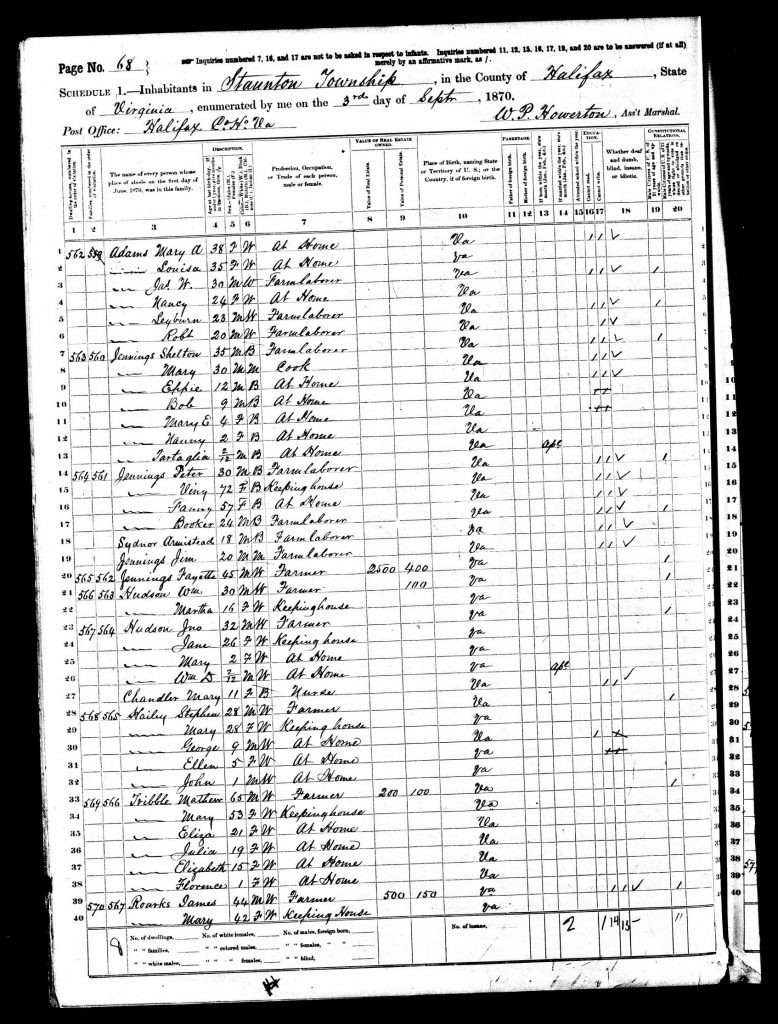
S. C. Haley is now determined to be Stephen C. Haley.
I was getting closer, but not there yet…..
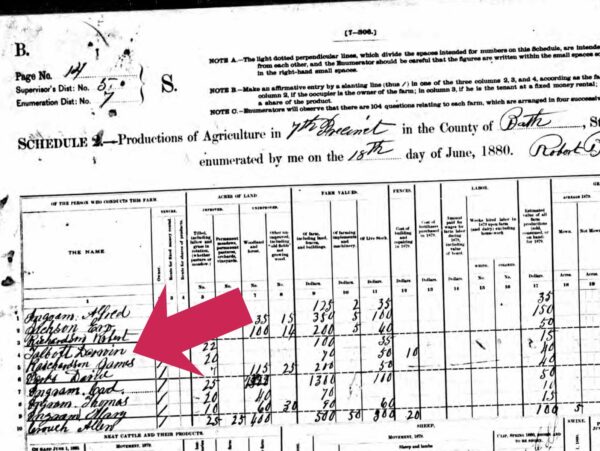
William Haley (approximately age 18 or 19) is not found on the 1880 federal census of any state. George W Haley (age 18) is found to be living in the household of James F Guthrie in the Staunton District of Halifax County, VA. George W Haley is listed as a farm laborer on the Guthrie farm. The Guthrie household is number 31. The household of Stephen C. Haley is 194 in the same district. Neighbors of the Haleys again included Mary Tribble, mother of Mary A Haley. This is the first record to show Stephen or S. C. Haley as being Stephen C. Haley.
This 1880 census shows George Haley living out of the household of Stephen C. Hailey and working as a farm laborer on another farm. This census also gives George’s middle initial as W. Could George’s middle name have been William? George is also listed as the same age as William would be. Interestingly, both S. C. and M. A. Haley went by their middle names as did several of their children.
Could they have continued the tradition with their son George?
By the 1900 census George Haley no longer shows up in the census records. William Haley (age 38) is living in the Staunton District of Halifax County, VA with his wife Clara [Holt] Haley and 5 children. William’s age and occupation as farm laborer continue to match what George’s age and occupation would have been. Steven C Hailey and wife Mary A (both age 62) are living in the Staunton District as well.
This was still not enough to definitively state George Haley and William Haley were the same man, but I was on the way.
🤔Stuck trying to find an elusive ancestor? Ready to stop the aimless search of the genealogy databases that leaves you frustrated and still NO results?
Check out the VIP Genealogy Intensive Day where we focus on getting your genealogy research back on track with a day dedicated just to Y-O-U. 😊
3. Use County Heritage Books For Local Family Knowledge
Halifax County Virginia Heritage 1752-2007 lists Stephen C. Haley’s full name as being Stephen Caswell Haley. His nickname is listed as Kas or Cas. Stephen Caswell Haley was known as Cas, and Cas was the father of William Haley.
[The genealogy “happy dance” may have ensued at this revelation!]

This information was submitted by Haley family descendants of Stephen C. Haley through his son Robert Alexander Haley. While the entry provides no formal source citations for the facts stated, a note was added that records from the Halifax County courthouse and family stories were used. The family stories are secondary sources in nature and yet support the limited oral tradition from William Haley’s descendants regarding William’s father.
Were William H. Haley and George W. Haley the same person?
When traditional records are placed alongside the Haley family’s strong oral history, the evidence supports that they were. The “why” and “how” George became William may never be fully known. A legal proceeding was not required for a name change during that time period. Regardless of which name he chose to go by, William Haley and his wife Clara left a rich legacy of strong family bonds that continue among their many descendants today.

Your Take Away for Researching Ancestors Who Changed a Name
When you research your ancestors, keep these ideas in mind:
- Research into brick wall ancestors is not quick. There is usually no one record that will provide the answer you are seeking.
- When you exhaust traditional records, think outside of the box. What other types of information and records can you find and use. These include people, written histories, personal papers, etc.
- Never trust just one source of information.
Do you suspect an ancestor changed his name? Let me know in the comments!



My ggUncle went by several names, I cannot find him after 1930 census. Don’t know when he died or where he is buried.
That does make him hard to research! Any idea why he went by several names?
My grandfather never knew his father and grew up in foster care. I am trying to see what happened to his father. He went by Kenneth then Georg. Same last name. My grandfather is 90 and I am trying to get this information to him soon. Anyone want a mystery to solve?
This is a major pain point for me in my Caribbean genealogy research. To this day it is not uncommon for people to use a completely different name than the one listed on their baptismal record. It makes it doubly complicated when the child was born to an unwed mother and took the father’s name after baptism. While I have been able to solve some of these mysteries, there are several brick walls I am currently working to break through.
My great uncle disappeared in 1903. I have military papers showing his discharge from services in Port au Prince. I also have census records in 1900 for a hospital in same city. I have a letter from him saying he would be home at a specific date. But he never showed up. His sister tasked me with the job to continue with the search. She a dectective on her payroll until she died in 1999. I called hospital in Port au Prince and they said most records from that time period are gone. Any suggestions as to what I can do next.
YES! I have hit a huge brick wall and I believe (quite strongly) it is due to a name change that occured. I cannot get passed it because everyone I keep talking to says I need “evidence” and “substantiated proof” that they are the same person. But I don’t know how to get that information…
He suddenly appeared in Washington in 1907 and the person I thought he was disappeared in Montana in 1900.
His extended family moved out to Washington a little bit later and then down to Portland, Oregon. Both of those times, my great-great grandfather resided in those areas.
But I do not have any proof or evidence that they collaborated or were together or did activities together. So- I’m not sure where to look.
My ggf Charles Andrew Branden was born in Wurtberg Germany abt 1876. He moved to Lynn Massachusetts and married Marion Jeffrey. The marriage record says his parent’s we’re Christian and Anna. And then nothing
My great grandfather changed his name from Jacquin to Jackson sometime after 1910.
Interesting! Do you think he was trying to Americanize his name? I’m always fascinated by the reasons a person changed their name.
Very little is known about my great grandfather who was supposedly from Olney, Illinois, and came to Arkansas where he met and married my great grandmother, Iola Meadows, whose family had also come to Arkansas from Olney, Illinois. His name was Benjamin Franklin Bailey and he is thought to have been born about 1867. They had one child, my grandfather, Ralph Fleming Bailey. The story goes that Benjamin got in a poker game and gambled away his employer’s mule team and wagon load of cotton, and fled for fear of being hanged. Family says great grandmother got 2 letters from him, from Mississippi and/or Louisiana maybe, and he said he was working and would send for her and the child, but he had been very ill. He was never seen or heard from again as far as the family knows. I’m at a loss to know where to look, I have exhausted all my ideas and haven’t found a trace of him other than in a census from 1870. I wonder if he changed his name and if so, if there would be any way to find his trail.
I am really interested in this topic. My gggf is a mystery and I have wondered if he changed his name. However, after struggling to read the nearly invisible print, I gave up. Am I the only person who finds light gray against white difficult?
Sheri, You are most definitely not alone in having difficulty reading those light documents. That’s a struggle many researchers have. Modern technology can help, though. I use Picmonkey (the free version) to help increase the contrast and make documents easier to read. You may be interested in this post I wrote on how I do that.
I wouldn’t mind looking at the records for you, if that would help. I also can speak German, which can be helpful with those old records.
Love the detail on how you tracked and analyzed the records! Very helpful! I’ve experienced a lot of name swapping, John Edward using Edward John or Ann Marie going as Marie Ann. On Official documents these family members use their given names but the Oral Histories and records like the census seem to be their other name. Then I’m entering them by their legal name and older family enter them as known in oral history. What fun!
Thanks for passing on your knowledge & experiences!
Another thought: do you record who the informant was on the death certificate? I haven’t been, but I am rethinking that after reading your blog. It may help with the timeline if that informant and help decide how much credence to give to the given facts.
Tina, I do record the name of the informant on a death certificate. Just for the reason you give, if I don’t know who the informant is in relationship to the deceased, I find out.
Hi Lisa, I DO remember this case from our ProGen class together. That was a very interesting story, indeed. I, too, have lots of AKAs in my family tree. Great Uncle Salvatore was better known as Willie. Grandma Salvatora was better known as Duda, Rosie and few other similar names. There are so many more. It does make things funny when you read obits of these people, and family ends up saying, “Who the heck is Salvatore?” Fun stuff. Sharon REIF
Hi, Sharon! Names are such fun! And so confusing……
Hi Lisa, This is a great ‘tutorial” for me – after I had the consultation with you recently, I began re-reading all the family correspondence I had regarding my “brick wall”, my husband’s grandfather. I began by making a list of all the facts, as well as the hints. Now, as I work through each hint, I am able to see other ideas and, as you suggested, checking out neighborhoods on the census records and other documents. Thanks for some additional ideas. You are such an encouragement! Thanks!
That’s wonderful, Phyllis! I can’t wait to hear how all of those hints turn out.
Very interesting article. I have an AKA with my ggg-grandfather, Jacob Tyson. He came to East TN in the 1830s and lived until 1900 as Jacob Tyson. While researching him, I got copies of his military records from the 1830s and included were many affidavits of those who knew him, claiming he had come to TN from Buncombe Co, NC and his real name was Jacob Stafford. My brick wall is I can find no records of a Jacob Stafford in Buncombe Co, NC. He also has a brother in these affidavits named Henry Hampton (not sure why all different last names!). I have found no information on a Henry Hampton and haven’t found a single document or record indicating a Jacob Stafford. Not sure how to proceed at this point!
This is a sticky research problem! Makes me wonder if Henry changed his name, too.
My husband changed his name about the late ’50’s. Over a period of time, he told several different stories about the where & why. We met & married Nov/Dec 1960, l did not know him at the time of the name change. I am documenting it in my records.
How very interesting!