
This post may contain affiliate links. Please see our disclosure policy.
Darwin Talbott left Halifax County, Virginia around 1848. According to his mother’s 1873 estate record, he was headed “west.” That’s the entire clue. No destination. Just two words, written by a clerk more than twenty years after Darwin was already gone.
For years, that’s all I had.
Family oral history said Darwin’s younger brother, John B. Talbott (my third great grandfather) traveled to Kentucky sometime after the Civil War to visit relatives. It’s strong oral history, and it’s consistent with known migration patterns out of Halifax County in that era. But oral history isn’t proof. I needed Darwin himself, on paper, in Kentucky, before any of it counted as fact.
I finally found him. It took two techniques that have nothing to do with searching harder and everything to do with searching differently: tracking the neighbor, and dropping the surname.
Here’s how it worked, and how to use both the next time your ancestor disappears from a record you’re certain they should be in.
The Oral History That Started This Search
Every family has a version of this story – a relative who “went west” or “went to visit family” and was never spoken of again with any specifics. Darwin’s was recorded almost by accident, written in the margin of his mother’s 1873 estate record when the family was settling an estate dispute in the Virginia chancery court system.
That record is worth understanding on its own. Estate records are full of these throwaway details of who was living where, who was already deceased, who had “gone west”, because the court needed to know who to notify. If you haven’t dug into how to research your ancestor’s estate record, this is exactly the kind of clue you’re looking for.
So I had a direction: Kentucky. I had a decade: sometime after 1848. And I had a brother’s oral history pointing at the same place.
What I didn’t have was Darwin.
Finding Darwin Where I Wasn’t Looking
What an Agricultural Schedule Actually Is
Most researchers go straight to the population census and stop there. But from 1850 to 1880, the federal census also included non-population schedules like the agricultural, manufacturing, and mortality schedules which were recorded separately from the household count. If your ancestor owned or worked land, the agricultural schedule exists whether or not you’ve ever thought to look for it.
I hadn’t thought to look for it either, until the population census gave me nothing. Once I did, I got a hit: Darwin Talbott, 1880 agricultural schedule, Bath County, Kentucky.
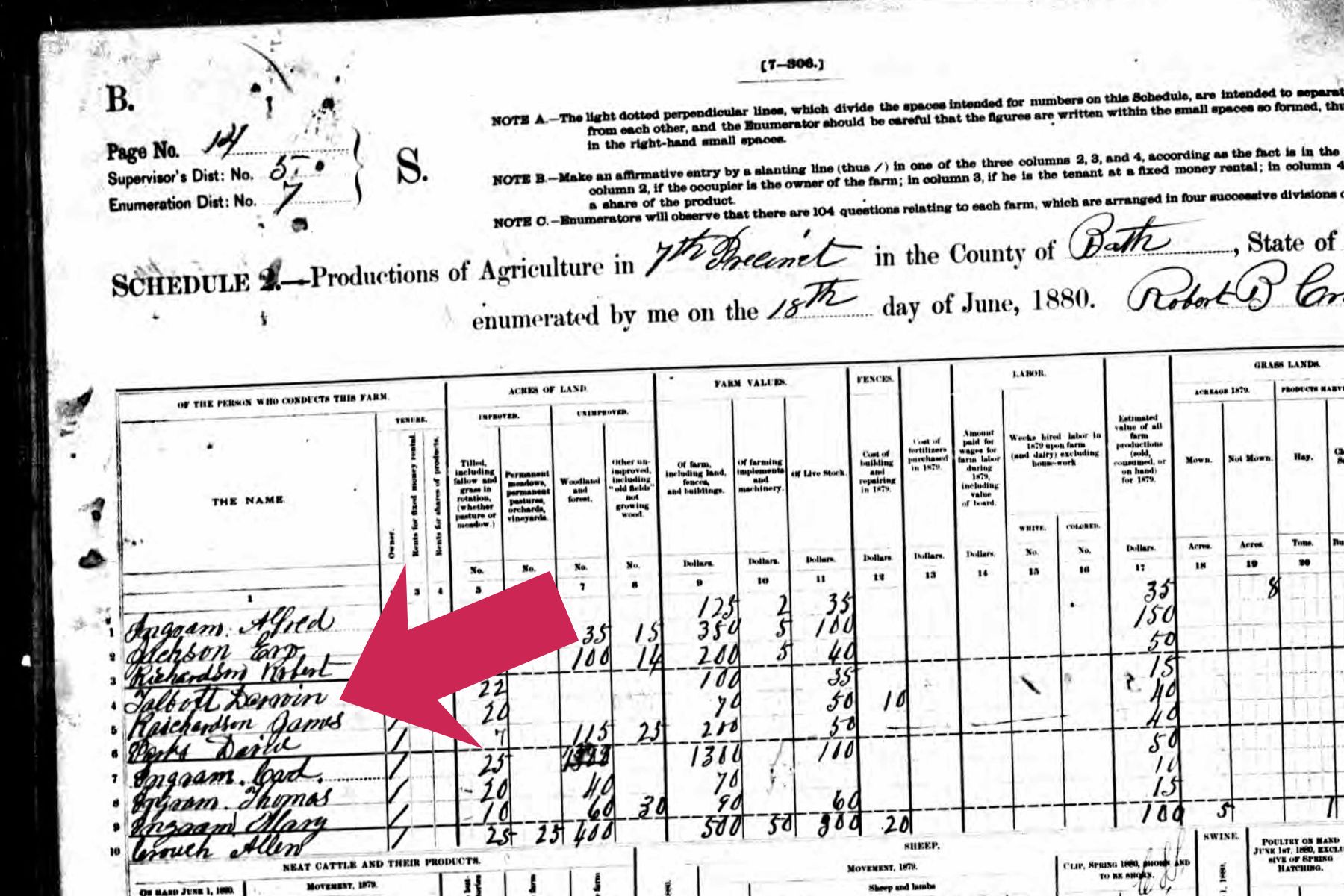
If you want the full picture of what that decade’s records can tell you, this closer look at researching the 1880 census is worth reading alongside this one.
A Family I Almost Didn’t Recognize
Here’s the part that should have been simple and wasn’t. Darwin was on the agricultural schedule. He was not as far as any name search could tell me on the 1880 population census for that same county.
He was there. The enumerator’s handwriting, or the transcriber reading it a century later, had turned “Talbott” into something a search engine would never connect to my family.
This happens more than any of us want to admit. A name search only works if the name was transcribed close enough to correctly. When it isn’t, your ancestor isn’t missing. They’re just invisible to the tool you’re using to look for them.
The Neighbor Was the Clue
Why Proximity in One Record Matters in Another
Census enumerators walked a route. They moved farm to farm, door to door, in the general order (though not exact order!) houses actually sat along the road. That means the households listed before or after your ancestor in one record often lived near them in real life and that proximity tends to hold up across different records and different years.
This is the same idea behind what genealogists call FAN club research: Friends, Associates, and Neighbors. You don’t just chase your direct ancestor. You build out who surrounded them, because those names often survive in the record even when your ancestor’s doesn’t. I’ve written before about how community and neighbor context in census records can crack a case, and this is that idea in action.
What I Found Next to Robert Richardson
On the agricultural schedule, the entry next to Darwin’s belonged to a man named Robert Richardson. Same page, same enumeration route, same neighborhood. No relation.
So instead of searching for Darwin again, I searched for Robert Richardson in the 1880 population census for Bath County. And there, right near the Richardson household, was a badly mangled entry for a Talbott family: a wife, Louisa, and two teenage sons, James and Joseph. Darwin’s family. Hiding in plain sight, one household away from a name I could actually search for.
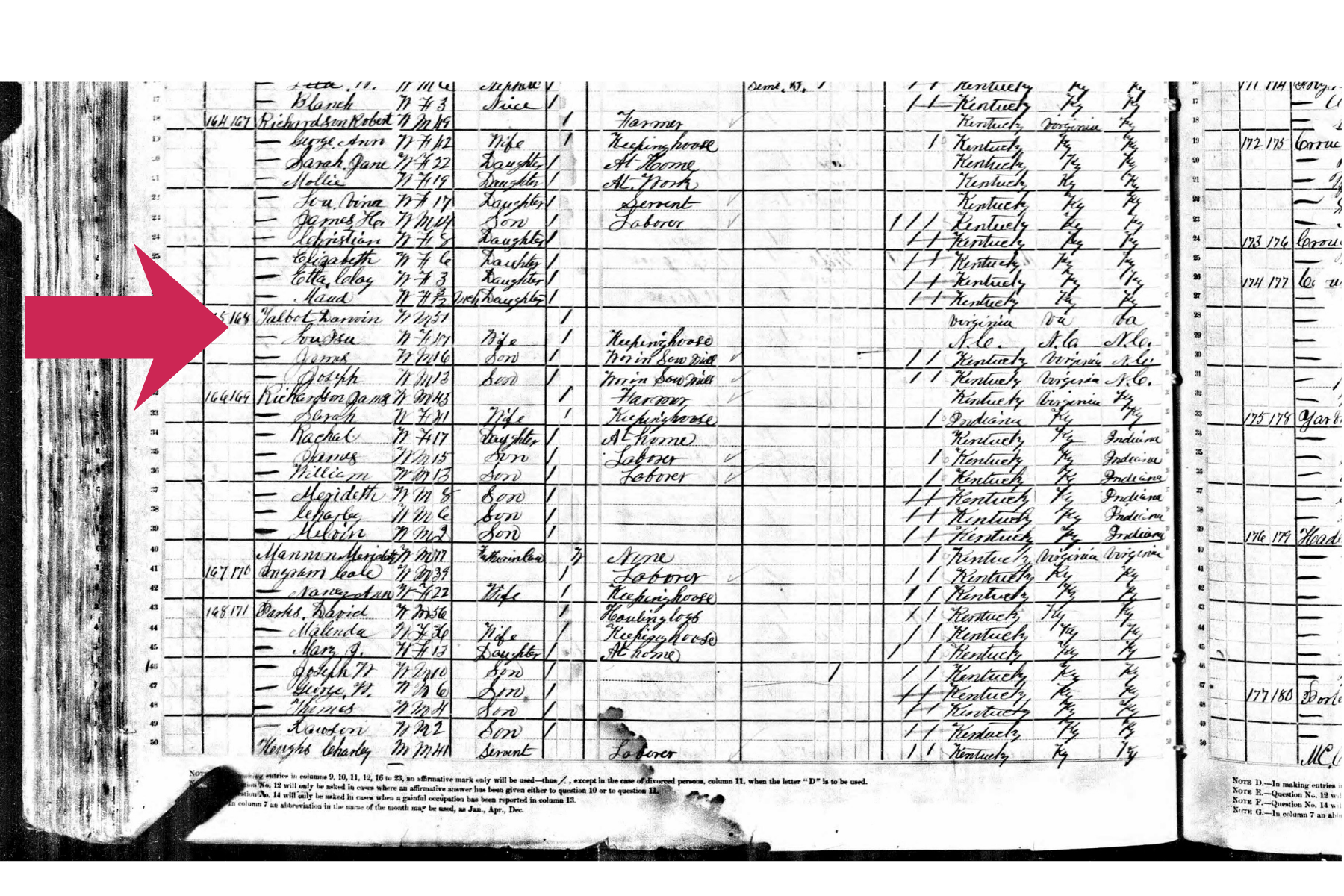
When a direct search for your ancestor fails, this is worth trying before you assume the record doesn’t exist: find someone who was clearly near them in another record, search for that person by name instead, and read every household around them.
Back to 1870 – And Dropping the Surname
Searching for a Family, Not a Name
With Darwin confirmed in Bath County in 1880, I turned to 1870 to trace him further back. Straightforward name search: nothing. Bath County, surrounding counties, wildcard spellings – nothing landed.
So I changed what I was searching for. Instead of a surname, I searched for a family unit: a man named Darwin, born around 1829, in Kentucky, with a wife named Louisa and sons named James and Joseph. No last name attached to the search at all.
That search found him in Estill County, Kentucky, in the 1870 census. Same wife. Same sons. A different county than where he’d eventually be found in 1880, which tells its own story about the path he took after leaving Virginia.
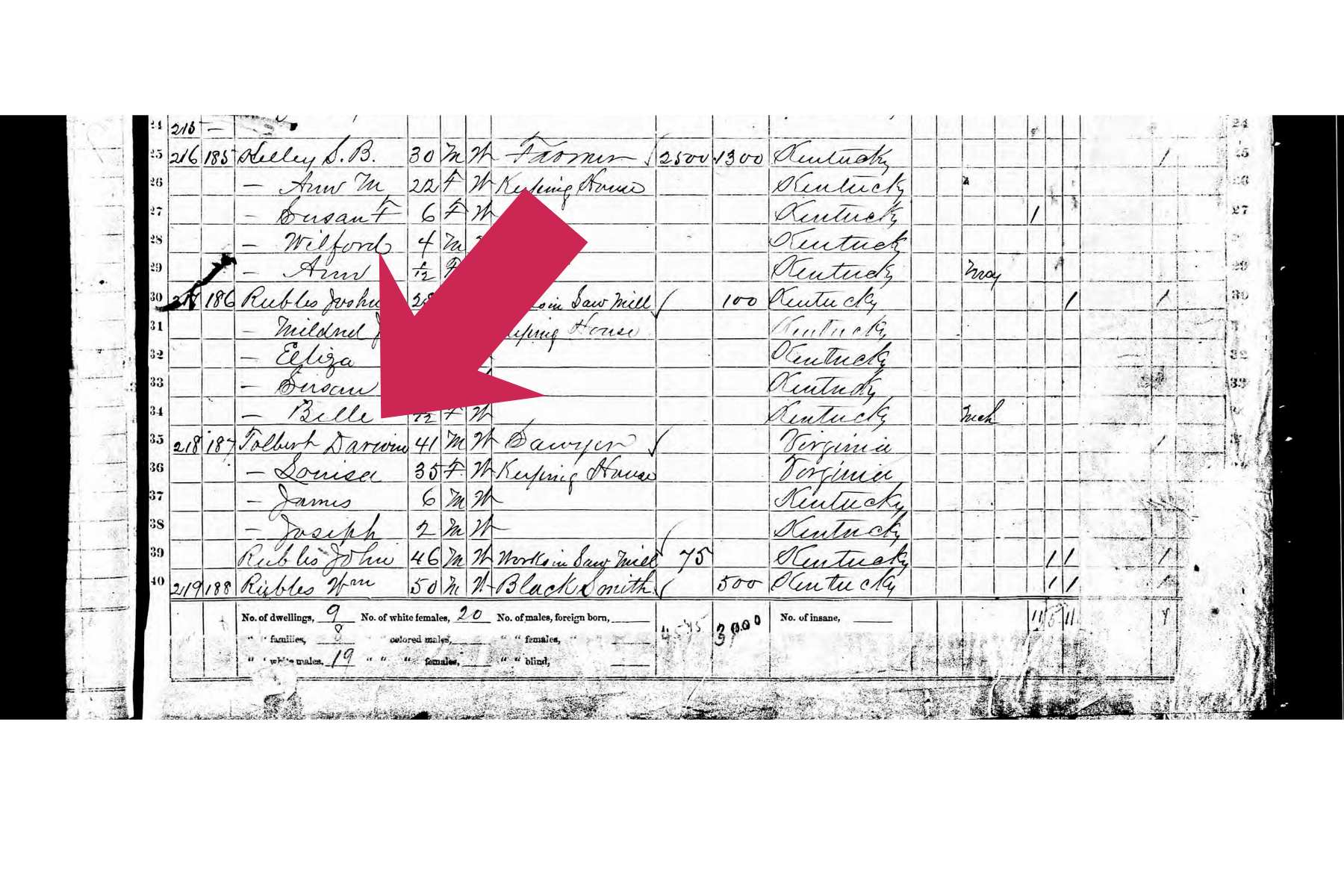
This is a technique I’ve written a full tutorial on researching your ancestor with a no-surname search and this is the case that proves why it works. A surname is only useful if it was recorded and transcribed correctly. A family made up of a first name, an approximate birth year, and the names of a wife and children is a lot harder to lose.
Two Techniques for When Your Ancestor Disappears
If you’ve hit a wall like this one, here’s what actually moved the needle, in the order I’d try them:
Track the neighbor. Find someone recorded next to your ancestor in any record – a census, a tax list, an agricultural schedule. Search for that neighbor by name in the record where your ancestor is missing, then read every household around them.
Search the family, not the surname. When a name search fails repeatedly, drop the surname entirely. Search on a first name, an approximate birth year, and the names of a spouse or children. Transcription errors take out surnames far more often than given names.
Neither of these is a shortcut. Both took me back through records I’d already searched, looking at them differently instead of harder. That’s usually what a brick wall actually needs.
As for Darwin, he was exactly where the oral history said he’d be. Kentucky, after leaving Virginia around 1848, close enough to where John B. Talbott’s own trip to visit relatives after the Civil War makes complete sense. The paper trail finally caught up to what the family had been saying all along.
If you’re sitting on a brick wall like this one and want another set of eyes on it, that’s exactly what a VIP Genealogy Intensive Day is built for — a full day of dedicated research on one specific problem.
And if you want more strategies for the moments when the census lets you down, grab my free guide, 5 Proven Strategies to Find Your “Missing” Ancestors in Census Records.


