
This post may contain affiliate links. Please see our disclosure policy.
Are you researching an ancestor born out of wedlock?
Do you suspect your ancestor was illegitimate?
If your answer to either question is “Yes”, then you have encountered the difficulties in researching an illegitimate ancestor.
Is it possible to determine the parents of an illegitimate child?
Sometimes.
Sometimes you know one parent (typically the mother, but not always).
Sometimes you only find circumstantial evidence pointing to the potential parents. The challenge is finding which records hold the clues you need.
What Types of Genealogy Records Should You Pursue When Researching an Illegitimate Ancestor?
Before we get into the records and resources let’s talk about the terminology you might encounter in your search. Some of the terms are no longer in use today or may be found offensive in today’s culture. Remember as you read the documents and as we discuss resources, the terminology used is of that time period and not necessarily today’s use of the word.
Common vocabulary encountered referring to a child when researching illegitimate ancestors:
- Base-born
- Bastard
- Born out of wedlock
- Natural
- Reputed – as in “reputed son of ”
- Imputed – as in the “imputed son of” indicates the mother was accusing the man of being the father
- Ignotus – Latin term for “unknown”; may be seen in church records
Oral History
Often oral history provides the best clues to identifying if your ancestor is illegitimate and/or who the parents are.
One of the interesting things I found in pursuing illegitimate ancestors, is what was common knowledge in one generation is not necessarily passed down to the next generation or two. This makes sense. Illegitimacy was (and still can be) a very sensitive topic and not one generally talked about openly.
Explore your family’s oral history surrounding your illegitimate ancestor. Reach out to collateral descendants, especially the older generations. The same oral history stories and information may have passed down a collateral line in your family but their version can hold different clues.
In every case where I discovered an illegitimate ancestor’s parents, reaching out to distant cousins proved crucial.
Be sensitive in your questions when looking for information. My experience proved one aunt had no problems talking about an illegitimate ancestor, while her cousin deftly changed the topic of conversation each time the subject was broached.
Vital Records
If you are researching in fairly “modern” times when birth and death certificates were being issued, be sure to check those. Often the father is not listed or listed as “unknown”, but you may get lucky and find the father’s name listed. Even a partial name will provide you a valuable clue.
Church Records
Evidence of a child born our of wedlock may be found within church records. If you do not know the child’s mother, the church records may help.
A woman who had a child out of wedlock may have been censored or excommunicated from the church. Check what records are available for the location you are researching. Are there any women being disciplined by the church for having an illegitimate child around the time your ancestor was born. Or if you know the mother, do you find her being disciplined? You can pick up clues to her identity here.
Bastardy Bonds and Apprentice Bonds
Bastardy bonds and apprentice bonds (from the colonial era up through 1913 in NC) are useful in determining one or both parents of an illegitimate child. Bastardy bonds are against the mother so you need to know the mother’s name. The father is sometimes named in these bonds if the mother was willing to name him.
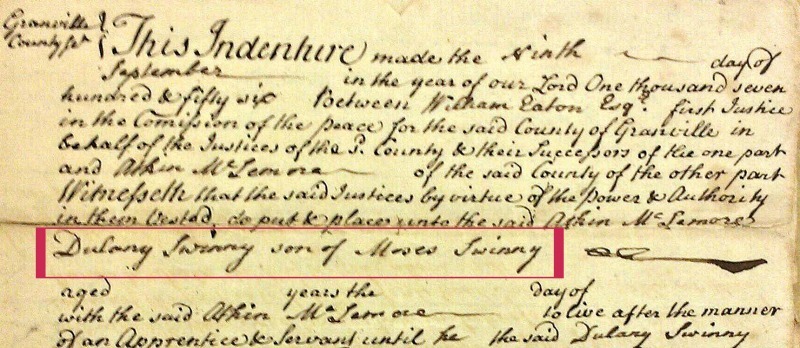
Apprentice bonds are also helpful. If your ancestor was apprenticed as a child (and this could be done at a very young age) the bond often will list the parent’s child. For example, Dulaney Swinney was apprenticed to Atkin McLemore in Granville County, NC in 1756. Dulaney was noted to be the son of Moses Swinney. If the child’s named parent is the mother only, then the child may have been born out or wedlock.
DNA Testing
The use of DNA to further genealogical research will certainly help in determining your ancestral line. While DNA is not a paternity test and will not tell you who the father of your ancestor was, DNA can potentially provide you with a surname or line you match. DNA can give you new avenues of research.
Mary Eberle of DNA Hunters talks about using DNA to find unknown parents in 7 Steps for Using DNA to Find Birth Parents of Adoptees & Others with Unknown Parents . Check out the YouTube Video, too! For an excellent DNA resource, I recommend The Family Tree Guide to DNA Testing and Genetic Genealogy by Blaine Bettinger.
Consider Other Potential Clues When Researching Your Illegitimate Ancestor
Sometimes you will pick up on other clues in the records that your ancestor may have been born out of wedlock.
Consider if:
- The mother named the child after the father giving you a clue to potential father candidate.
- Was money involved? If the child’s father was from a wealthy family, a woman may have sued for money to support the child. Check the court records. [Note: Outside of bastardy bonds, I rarely find this to be the case.]
- Illegitimate children usually took the mother’s surname. In cases where they took the father’s surname, the father generally acknowledged the child.
Remember….
Researching ancestors born out of wedlock is not easy or quick. It can be a very sensitive topic within a family. Sometimes the best we can do is build a circumstantial case with the clues we do find. Then we wait for the next bit of information…..
🤔Stuck trying to find an elusive ancestor? Ready to stop the aimless search of the genealogy databases that leaves you frustrated and still NO results?
Check out the VIP Genealogy Intensive Day where we focus on getting your genealogy research back on track with a day dedicated just to Y-O-U. 😊
Other Posts You May Enjoy
- 7 Tips For Successful Genealogy Research In A Burned County
- How to Determine Your Ancestor’s Birth Date (Even If No Birth Record Is Found)
- How To Pull the Stories From Your Ancestors
***Please note that this post contains affiliate links which means I may earn a commission if you decide to purchase a product/service. This does not cost you extra. Be assured I only recommend products/services that I use and think you would like too. Read my disclosure policy and privacy policy.



My grandmother had twin daughters unwed and given up for adoption ?!?! between 1908 and 1920 in West Michigan… She was married in 1922 and had 10 more children (2 sets of twins) …. My question is: How do I find my illegitimate Twin Aunts????
Looking for my greatgrandma owllooking, her parents would be my grate grate grand parents
My mother passed away in 1974 when I was 7. I found out later that she was the result of an affair with a married man. My grandmother wrote her ex husband as the father on the birth certificate. The story I heard was the father was married and did not want to leave his many children and that he played the piano. I have done my dna and have cousins that don’t match any other family members so I assume it has to be my grandfather. Of course these cousins deny that an affair could happen. I believe their grandfather is the same as mine but it is difficult to confirm. Not sure if this helps shared dna is 410cM across 22 segments. Any tips. Joan
Looking for my grand parents.by the the name of Holiday
I am not sure if my ancestor was illegitimate or not. What I am trying to determine is his parentage, because he and his children are listed as “mulatto” on the 1910 census, and I would love to know if he is a product of a consensual relationship or the child of slave abuse. I wonder how to start looking for that. His birth records seem to not be listed with the state, so I don’t know where to go from there. He also “whitewashed” his ancestry, as by the late 1910s and 1920s, he listed himself as white. Any tips where I might start?
This is definitely a tough problem. First, go back through earlier census to see how his race was listed. See if you can find him in the home of his parents. Additionally, DNA testing can help. You might need a DNA expert to help you process the results.
My late husband was middle child of seven. No marriage lic to be found for his Mom.
His oldest brother had a Dad, he and two older brothers had a Dad, his sister had a Dad, his Younger brother had a Dad and youngest sister had a Dad.
What a mess!
Wow, that does get complicated fast!
My mother was born out of wedlock. Mary Jane Lennon. Her birth certificate (not sure it is hers) states that she was born on 04/18/1923 to Morgan Johnson and Stuart Lennon. My uncle (her half brother) is convinced that it is her birth certificate. Indeed her birth date was the same, the age of the mother is correct but her mother’s given name was Helen Margret Lennon. Any clues as to how I find out about this birth?
The father listed on my mother’s birth certificate is incorrect since she had an affair. The family openly acknowledges my mother is the daughter of the man she had the affair with. But they haven’t (and I doubt they would) amend or correct her birth certificate. I am interested in applying for Italian citizenship through descent since my mother was born before 1948. Would genetic testing help in this situation?
You would need to check with a specialist in Italian citizenship or an Immigration lawyer. I’m not sure if Italy will accept genetic testing.
We have been searching for Robert’s grandfather’s birthdate and birth parents of Harry McLeod.
Supposedly born October 1886 in Moncton, NB, Canada.
We have found nothing.
He was brought up by his ‘uncle’ Vincent McLeod (who was from Prince Edward Island, Canada.
We found a 1991 census from Canada that lists Harry as a ‘boarder’ (at 4 years old) with Bessie Mackenzie (another boarder) living in the household of Vincent and Louise McLeod.
The next census is from Massachusetts in 1900 where Harry is Vincent and Louise ‘s son (but they list having no children).
But we can’t find his biological father and mother
Is there any help here?
My Great Grandfather born 1852, was adopted papers list his Mother as Jane Jones
Would DNA testing be of any value after such a long time?
Hi, Sharryn, It could be. Here is a post Mary Eberle of DNA Hunters wrote for me that is a good place to start: https://lisalisson.com/dna-find-birth-parents-adoptees/