
This post may contain affiliate links. Please see our disclosure policy.
When traditional genealogy sources hit a dead end, school records offer overlooked information about your ancestors that can change everything. These records can break through research barriers, provide missing dates, and reveal family connections that census records missed.
If you’ve been researching for years but haven’t explored school records, you’re missing a powerful tool that can fill gaps in your family timeline and provide rich social context for your ancestors’ lives.

Table of Contents
- Why School Records Matter More Than Most Researchers Realize
- Don’t Forget…
- The Five Types of School Records Every Genealogist Should Know
- Where to Find School Records: A Strategic Search Plan
- Strategic Research Approach: When to Use School Records
- Making the Most of Your School Record Discoveries
- Getting Started This Week
Why School Records Matter More Than Most Researchers Realize
School records serve as unofficial censuses, often capturing families during years when federal records are missing or incomplete. The destroyed 1890 census left a crucial 20-year gap in many family histories, but school records from that era can help bridge those missing decades.
Unlike federal censuses taken every ten years, many school records were created more frequently, giving you additional snapshots of your ancestors’ lives. They’re particularly valuable for:
- Finding female ancestors before marriage when their names changed
- Establishing family groups when children attended school together
- Confirming ages and birth years during pre-vital record eras
- Discovering parents’ names and occupations through guardian information
- Tracking family movements as children changed schools
Don’t Forget…
School records serve as unofficial censuses, capturing families annually rather than every decade – making them perfect for filling gaps in your family timeline.
The Five Types of School Records Every Genealogist Should Know
1. School Census Records and Registers
School registers list students who attended each year, often including ages, parents’ names, and even occupations. These annual snapshots can substitute for missing federal census years.
What you’ll potentially find: Student names, ages, attendance days, parent/guardian names, sometimes occupations
Research tip: Look for clusters of children with the same surname – they’re often siblings or cousins attending together.
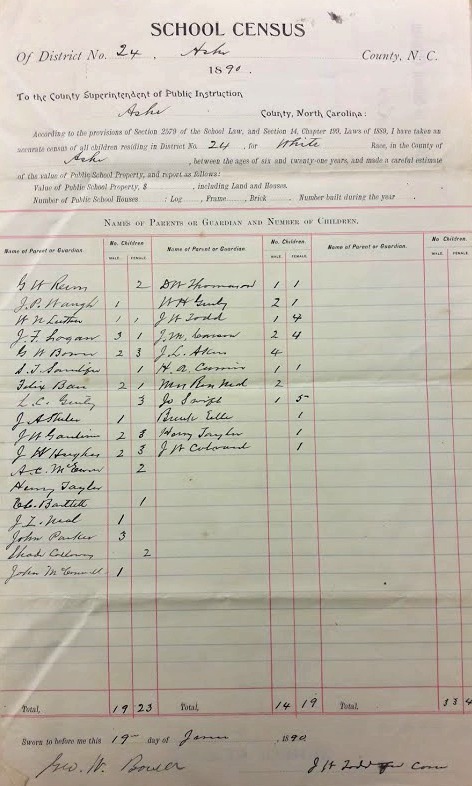

Reading across to the second page, we find the parent or guardian’s name is AND their occupation!

2. Yearbooks
Beyond photographs, yearbooks contain graduation lists, club memberships, sports teams, and faculty information. They reveal your ancestors’ interests and social connections.
What you’ll find: Photos, activities, friendships, academic achievements, sometimes home addresses
Research tip: Check yearbooks from surrounding years even if your ancestor wasn’t a graduate – they might appear in underclassman photos or activities.

3. School Newspapers
Student newspapers capture the social history of your ancestor’s community and reveal what mattered to young people of that era.
What you’ll find: Student achievements, local events, social activities, community news
Research tip: Search for your ancestor’s name in all issues from their school years, not just graduation year.
4. Annual School Reports
County superintendents’ reports to school boards sometimes include honor rolls, perfect attendance lists, graduation rosters, and community statistics. While included here for completeness, these reports are typically a last resort when other school records aren’t available – the information is often limited and less detailed than other school record types.
What you’ll potentially find: Achievement lists, graduation records, community demographics, educational statistics
Research tip: Use these when you’ve exhausted other school record options. They’re better for understanding community context than finding specific family details.
5. Report Cards
Personal report cards reveal family dynamics through parent signatures and provide precise age information through grade placement.
What you’ll find: Parent/guardian signatures, exact school years, academic performance, teacher names
Research tip: Parent signatures can help verify handwriting in other documents or confirm guardian relationships.

Where to Find School Records: A Strategic Search Plan
Start with Family Collections
Before searching archives, check with extended family members. Many families preserved yearbooks, report cards, and graduation materials that never made it to official repositories.
Action step: Create a list of all family members and cousins who might have inherited school memorabilia.
Online Genealogy Databases
Major platforms now include substantial school record collections:
- Ancestry.com: Use the Card Catalog to search “school records”
- FindMyPast: Strong collection of UK school records, including a few U.S. collections
- MyHeritage: International school records collection, including US and worldwide holdings

Search strategy: Don’t just search your ancestor’s name – search the school name or district to see all available records.
State and Local Archives
State archives often house school district records that aren’t digitized yet. Many have online finding aids that can guide your research.
Research tip: Call ahead to ask about school record holdings – archivists can save you time by directing you to the right collections.
University Special Collections
Local universities often collect area school records as part of regional history preservation efforts.
Action step: Use ArchiveGrid.org to search special collections nationwide for school-related materials. (Learn more about maximizing ArchiveGrid searches in my guide to using this powerful research tool.)
Historical Societies and Museums
Local historical societies frequently preserve school memorabilia, yearbooks, and photographs that families donated over the years.
Strategic Research Approach: When to Use School Records
School records work best when used strategically rather than as random searches. Consider school records when you need to:
Break through brick walls in the 1880s-1900s: School records can bridge the gap left by the destroyed 1890 census.
Find female ancestors: Young women appear in school records under their maiden names before marriage records are available.
Establish family connections: Children attending school together often reveals sibling relationships not documented elsewhere.
Confirm conflicting information: School records provide independent verification of ages and family relationships found in other sources.
Making the Most of Your School Record Discoveries
Document Everything
School records often exist in single copies with no backup preservation. Photograph or scan every page, even if your ancestor isn’t immediately visible – you might spot them later or find relatives.
Look Beyond Your Direct Ancestors
Search for siblings, cousins, and known associates. School records reveal community networks that can lead to new family connections.
Note Social Context
Pay attention to curriculum, activities, and community information in school records. This social history enriches your ancestor’s story and explains their life choices.
Cross-Reference with Other Records
Use school record information to search more effectively in other record types. Parent names from school registers can guide your search of property records or voter registrations.

Getting Started This Week
Ready to explore school records for your research? Start with these three actions:
- Map school-age locations: Identify the counties and towns where your ancestors lived during their school-age years (roughly ages 6-18), even if you don’t know the specific schools they attended.
- Search online first: Check Ancestry’s Card Catalog for school records in your ancestor’s county.
- Contact one local repository: Reach out to the historical society or archives in your ancestor’s area to ask about school record collections.
School records represent some of genealogy’s best-kept secrets – comprehensive, detailed, and often completely ignored by other researchers. While everyone else searches the same census records, you’ll be discovering rich family details that bring your ancestors’ educational experiences to life.


Modern school records might not be so easy to find. I graduated from high school in 1970 and when I asked about obtaining a copy of my school file, I was told they were destroyed after X (maybe 10?) number of years. I actually got photocopies of my elementary school records because we moved from one town to another when I was in the sixth grade. Because I didn’t finish the school year there, my records were stored in the basement in file cabinets and not sent on anywhere else. They apparently only photocopied my file to send on to my new school. I feel very lucky to have copies of my kindergarten reading skills tests and notes by my teachers that I had to be prodded to talk!
You make a good point, Linda. A modern student’s personal record will not likely be saved or if it is not public. Thanks for pointing that out.
Another initial source that lead me to the highschool in Pennsylvania was a class ring. On the side of it was the impression of the actual building and the other was the year. We only knew generally where the family was from at this point and were cleaning up the ring to give to his grandson when we noticed the clues. The building no longer stands but checking with different local museums as you suggest not only helped us find the school but they had the yearbooks and were happy to make copies of our ancestor’s pages including his nick name and what he aspired to be. Gold!
What a great story! I had not even thought about using a class ring, but you really thought outside of the genealogy box. Well done!
I have made a cursory scan of school records information and found only US information. What about Canadian (Ontario) school records? Where do I find those? There seems to be an abundance of information on US genealogical search categories, but precious little about Canadian genealogical search categories, which is frustrating.
Carolyne, Ancestry.com has some Canadian school records including yearbooks and what looks like a type of school census or listings. It seems hit or miss though. Contact the Canadian archives and ask what type of school records would have been kept and where they are currently kept.
I have my Mothers High School yearbook from 1923! So fun to read all what some wrote in it. She was evidently in school plays and the comments were about her and how others liked her and wanted her to go on to the “big city”…she wanted to but her parents balked at that….
In some cases you may not know the school your ancestor attended. I have found that many county historical or genealogical societies have published county heritage books in many states where families place their family history with photos and genealogy. In many cases they also mention the schools the children attended. This has helped me in getting a photo of relatives that I did not have from yearbooks. Yes, I alway check and confirm what is in print in these books, I use them as a referrance only.
On a trip to Colorado, we toured the South Park City museum – where you walk through the old buildings in the old town. In their School House building, they had behind Plexiglas on display an old grade book along with text books and other artifacts of the school. I wonder if these are scanned somewhere? I wonder if someone who needs them would be able to search them?
You never know where you will find records. Keep your eyes open!
I was able to find school records for Washington State on FamilySearch.
Good to know! Thanks!
I am so excited to be among your blog links for the week!
I was shocked. Most school records (School Attendance Records – transcripts-Health Records-Awards) are supposed to be kept 100 years and put on microfilm. For those parents, grandparents and others make sure your school boards are advised of this for future generations. Records should be held in file cabinets 1 year then transferred to microfilm. If one wants to digitize for day to day useage that can be done at any time, but your microfilm is your base program. Please, Please get that word out to everyone and anyone. It is history! (Historian and Preservation is my line of work)
Thanks so much for this, Loraine! Privacy for individuals is of utmost importance. I should clarify (and I apologize for any confusion), in talking about “school records”, I’m not including transcripts and health records. I’ve never seen these (outside of when I worked for a school system), nor would I expect to. The report cards and awards can sometimes be found among a family’s keepsakes. Thanks, again!
Hello Lisa L
I came upon this website through a google search . I would love to look up my parents educational history schools they attended. I would also like to share a photo of my late mother she could be your twin .