
This post may contain affiliate links. Please see our disclosure policy.
Do you know what your ancestors looked like?
Not just a vague sense of “she had the family nose” — but actual physical characteristics. Height. Eye color. The shape of someone’s chin. Whether they went bald. Whether they had a scar or a tattoo that marked them as someone who’d lived a full and complicated life.
If you have photographs, you have something. If you don’t – and most of us don’t, at least not for the ancestors we most want to see – you may have more than you think.
This post covers the resources I know of for uncovering what your ancestors looked like. Some are obvious. Several are not. And a few are genuinely surprising.

What is a Doppelganger?
In German folklore, all living things have a spirit double. They referred to that spirit double as a doppelganger. Other folklore traditions refer to a doppelganger as an “evil twin”.
I prefer the friendlier modern definition. The modern definition of a doppelganger refers to a “look alike”. Someone who looks very similar to you.
As genealogy researchers it is of no surprise we wonder if that look alike (or look alikes!) are in our family tree.
The next question becomes…..
How Do Find Out What Our Ancestors Looked Like?
Wondering if you inherited those cheekbones from Great-Grandma Millie you never met? Our ancestors may not have taken as many photographs as we do today, that makes uncovering their looks a genealogy thrill.
We’ll explore some surprising resources, from dusty documents to cool tech tools, to help you become a detective of your family’s facial features. Let’s see if you have a lost twin is hiding in your family tree!
Photographs
Being able to see a photograph of an ancestor is on every genealogy researcher’s wish list. If the photographs do not exist in your family, how do you find old family photographs?
You have a number of options for finding photographs of your ancestors outside of your family.
Distant relatives and collateral genealogy researchers – Remember other family lines (collateral lines) may have photographs of your ancestors. Reach out to them. You’re family history and photos may be in their closets.
Yearbooks – Yearbooks are an underutilized source of genealogical information. Of course, you’re after those photos!
If you know when and approximately where your ancestor went to school, local libraries and historical societies often hold physical copies. School yearbooks are one of the most overlooked genealogical sources not just for photos, but for candid details about personality and community standing that you won’t find in any official record.
County Histories – County histories are typically user submitted information, and this is a good thing for you the family researcher. The submitter will often provide a photograph(s) of one or more ancestors.
Flickr – Check university and state archives collections.

Vertical Files – Check local and regional libraries in the areas where your ancestors lived. You can find “new to you” photographs and lots of other pertinent genealogical information.
The Internet Archive – Find community histories and family albums. Below is an example of a family photo album found on the Internet Archive.

Hidden Photo Clues in the Photos You Already Have
Before you go searching for new photographs, it’s worth squeezing every clue out of the ones you already have. Old family photos contain more genealogical information than most people realize — details about approximate date, location, occasion, and even identity that aren’t immediately obvious.
There are hidden clues in old family photographs hiding in plain sight: studio backdrops, clothing details, jewelry, and props that narrow down when and where a photo was taken. If you’re working with unidentified photographs, this is your starting point before anything else.
And if you want to go deeper into photo identification specifically, I have a full post on four methods that actually work — including how to use collateral family members’ photos and historical context to make an educated match.
FamilySearch Compare-a-Face
For those with family trees on FamilySearch.org, Compare-a-Face is genuinely fun — and still one of the more useful tools for this specific question.
The tool uses facial recognition technology to analyze a photo of you alongside ancestor photos in your FamilySearch tree. It gives each pairing a resemblance percentage and ranks relatives in order of similarity. You’ll need a free FamilySearch account to use it. Head to familysearch.org/discovery/compare to try it.
A few honest notes before you get your hopes up: results vary significantly based on photo quality, angle, lighting, and how similar the ages and hairstyles are in the photos being compared. A formal Victorian portrait taken at a flat angle is going to read differently than a candid snapshot. Take the percentages as a fun starting point, not a scientific verdict. The tool is confirmed active and was highlighted in FamilySearch’s 2025 year-in-review as one of their most-used discovery experiences — so it’s not going anywhere.
Share your results in the comments. The range of what people find is genuinely entertaining.
AI Tools That Let You See Your Ancestors Differently
This is where things have gotten genuinely interesting in the last few years.
MyHeritage has built out a suite of photo tools that go well beyond basic enhancement. The three worth knowing about for this specific question:
Deep Nostalgia — Upload a photo of an ancestor (or pull one from your MyHeritage tree) and the tool animates the face: blinking, slight head movement, the suggestion of expression. It is not a re-creation of how your ancestor actually moved. MyHeritage is transparent about that, it applies pre-recorded gesture sequences to the facial geometry in the photo. But seeing an ancestor you’ve only ever known as a still image suddenly blink? It hits differently than anything else in genealogy. When Deep Nostalgia launched, it spread across social media almost instantly because the emotional reaction was universal. The free access gives you a limited number of animations; a subscription unlocks more.
In Color — This colorization tool takes a black-and-white photo and generates a plausible color version. Hair color, eye color, clothing, skin tone are all extrapolated from the photo’s tonal values and historical context. Again, not documentary accuracy. But enormously useful for making an ancestor feel like a real person rather than a sepia ghost. Works on both uploaded photos and photos already in your MyHeritage tree.
Photo Enhancement — This one’s more practical: it sharpens and clarifies blurry, damaged, or low-resolution photos. If you’ve got a photo where the face is identifiable but fuzzy, this is the tool that might make it usable.
These tools are all available through MyHeritage. The platform is also where you’d take a DNA test if you want to connect your physical resemblance to actual genetic data — more on that below.
🖼️Old photographs don’t give up their information easily.
Cracking the Family Photo Code is a $37 webinar that walks you through how to get more out of every photo in your collection — identification methods, dating techniques, what to look for beyond the obvious.
Can DNA Tell You What Your Ancestors Looked Like?
Not with precision, but it’s getting there.
Both MyHeritage and Ancestry offer DNA testing that gives you ethnicity estimates and cousin matches. Neither test will hand you a portrait of your 3rd great-grandmother. But what DNA can do is help you find living relatives who may have photographs, family stories, or physical descriptions you don’t have access to yet.
The practical move: take a DNA test, work your matches, and reach out to cousins in your match list. The ones with family trees attached are the most useful starting point. You’d be surprised how often a cousin two or three times removed has a photo you’ve never seen.
MyHeritage’s chromosome browser and Smart Matches tools make it particularly useful for cross-border research — if your family came from outside the US, their international database coverage is worth knowing about. Ancestry’s Thrulines feature connects your DNA matches to specific ancestors in your tree, which can be helpful for identifying which branch a potential photograph might come from.
Find What Your Ancestor Looked Like Even Without A Photograph
What about those ancestors you just cannot locate a photograph for? It certainly happens. In my own family history research, I have experienced that.
Are we just out of luck when it comes to knowing what our ancestor may have looked like? Not necessarily. Records exist that will give you a physical description of your ancestor. Some of these descriptions are quite detailed.
WWI and WWII Draft Cards
Draft cards include a man’s height (tall, medium or short), weight (slender, medium or stout), eye color, hair color, if bald and physical deformities.

Physical descriptions found on WWI draft cards helped me identify photographs once belonging to my great grandmother Esther Richardson. Esther was a beauty and sought after eligible young woman. Fortunately for me, she saved all of her letters and postcards from her potential suitors. I was able to match the young men’s names with their WWII draft cards and find their physical descriptions. Those descriptions provided valuable clues to identifying unidentified photographs that had been in Esther’s collection.
Civilian Conservation Corps (CCC) Records
CCC records are very complete and descriptive of the individuals. These records include height, weight, eye color, hair color, complexion, and physical deformities. CCC records are not online and must be ordered from NARA. Be forewarned these can be expensive!

Jail Records
Jail records will include such descriptors as height, weight, eye color, hair color, tattoos, scars, physical deformities. Some will provide mug shots, but not all.
Note: Individual state’s privacy laws can limit the researcher’s access to these records. For example, jail records in North Carolina regardless of the time period are not available for research purposes.
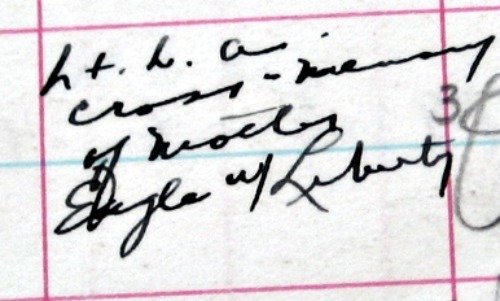
Notice just one of the details on this inmate of Deer Island, NY in 1940. On his Left lower arm is a tattoo of a cross in memory of his mother and a tattoo of an eagle with Liberty.
Early prison records from Sing Sing prison also offer very detailed descriptions of individuals. In this example, you come away with a good idea of what the inmate Charles Miller looks like. Charles was 5’9″ tall and weighed 164 pounds. He had a ruddy complexion, hazel [?] eyes, dark brown hair and a “small dark mole on the left side of nose”.

Passport Applications
The information found on passport applications will vary based on the time period you are research, but they are absolutely worth checking. Below is a the passport application for my husband’s great grandparents Abraham Jacobs and his wife Minnie that included their photographs.
(Yes, there might have been a genealogy happy dance occurring when I found those photos!)
Besides the photographs, passport application can include descriptions of height, weight, eye color, forehead, face shape, chin, mouth, hair color, complexion, and physical deformities. That’s a lot of information for a physical description. Even without a photograph, I would have a good idea of what the couple may have looked like.
Passport applications are available on Ancestry — search under “Passport Applications.” The amount of physical description information included varies by time period, but applications from the early 20th century are often the most detailed. Even without a photograph, a passport application from 1921 might tell you someone was 5’6″, had brown hair, gray eyes, a round face, and a medium complexion. That’s enough to start seeing a person.

Ship Passenger Lists
If your ancestors immigrated, ship passenger arrival records are worth checking — not just for the journey itself but for the physical descriptions often included. Ancestry has an extensive collection of passenger lists. Many early 20th century records include height, complexion, hair color, and eye color for the immigrant. It’s not a photograph, but it’s a description from someone who saw them in person.
Check out this deep dive on ship passenger lists for a fuller look at what you can find there.
City Directories
City directories won’t give you a physical description, but they will tell you exactly where your ancestor lived and worked — which can point you toward local newspapers, church directories, and community histories that might include a photograph you haven’t found yet. City directories are an underutilized resource for this kind of contextual research.
Death Certificates
Death certificates don’t typically include physical descriptions, but they point you toward informants, often a spouse or child who was present, and can open up lines of inquiry into military records, institutional records, or local newspaper obituaries that might include a photograph or physical details. There’s more genealogical information in a death certificate than most people expect.
Oral History
Don’t forget your family’s oral history. While you may not get specifics, you can get clues to general characteristics. Statements like “The Carrs were always short.” It may not be much, but you can begin to see which characteristics you inherited from which side of the family.
Keep Looking
Maybe you’ve found a doppelganger. Maybe you’ve found a dozen. Or maybe you’ve confirmed that whatever you inherited – the height, the hairline, the stubborn chin – came from a branch you haven’t fully traced yet.
Either way, the search for your ancestors’ faces is genuinely worth doing. Physical descriptions in records bring people to life in a way that dates and places alone can’t. And the tools available now – between DNA, photo AI, facial recognition comparison, and the sheer volume of digitized records available through Ancestry and MyHeritage – mean there are more options than there have ever been before.
The photographs, the records, the DNA: they’re all pointing at the same people. It’s just a matter of pulling the threads.
If you want to go further with the photographs you’ve already found, here’s where to start:
- How to Identify Mystery Faces in Old Family Photographs
- 9 Proven Ways to Find Old Family Photos
- Family Photo Organization: A Simple 6-Step System
- Colorize Family Photos with MyHeritage In Color
Free download: What Is That Family Photo Really Telling You?
A quick-start guide to reading old photographs for genealogical clues — dating, identification, and what to look for beyond the obvious.


Thanks Lisa. I am still looking for Susanna Ikerd!!
Hang in there, Donna!
I found my doppleganger! My Fathers long dead younger sister who we had never met. He was told she died as a little tot….not true.
Oh wow, that’s fascinating.
Churches sometimes put out directories with pictures. Also, newspaper notices of missing persons and possibly descriptions of people found victims of foul play, coroner’s reports.
Lorraine, more great places to look. Thanks!
I do not look like my 2x g grandfather but he is a Doppleganger for Wilford Brimley!
Oh, wow!
I have a photo of my grandmother at age 16. My great granddaughter is a doppelgänger of her!
How fun is that!
Happy dance!!! While reading a newspaper article about a trial in 1865, which stated the address of my relative, I glance at the ARTISTS SKETCH showing my Great Great Grandfather, who they were questioning!
Woohoo!!! Definitely, happy dance time!
I have had a doppelganger almost everywhere I have lived. While stationed in Germany with the US Air Force, I was mistaken repeatedly for someone else and even got introuble at work when my boss said he saw me at the Base Exchange after he told me to stay at work. If not for another employee statement and those of the guys in the next office I would have been in real trouble. Never met the doppelganger. There was a man who worked in an office upstairs from where I worked, everytime I had to go to his office or he saw me in the hallways, he would leave quickly. One day he was alone in the office and I stopped him as he was making for the door. I asked what I had done to make him so anxious to leave everytime he saw me? With a very sad face he sat down and pulled out his wallet. He said I look just like his late wife and he showed me her picture. I couldn’t tell you that it wasn’t me. We looked exactly alike. His wife died in a concentration camp during WWII. Not because she was Jewish but because she took in a Jewish child who ran away when her parents were being arrested. The little girl lived with them for over a year and while he was away, the soldiers came and took them both away. He never saw either of them again.
I cried and cried. He cried too. He never avoided me again and we became good friends.
I was wandering through the internet, when I found an old family book, written by my 7th great grandmother’s grandson. (The brother of my 6th great grandfather’s son) As I opened the the pages, there were photos. The second face I saw, that of his wife, it gave me chills. I look just like her! I haven’t figured out, yet, how we are related, by actual bloodline, but I really want to know. Both sides of my family lived in the general area, back then.
I also, wanted to ask you about where you get your photos, please? One of the subjects in one of your photos, is a woman who looks just like my dad. I’d love to know who she is. Thank you!
There is also the California Great Register of Voters, which covers the years 1866 to 1910 (as well as some other years in a few places), and includes a description of the person.